

From pattern to product: how Onetree’s product team turns experience into solutions
Weavee and Datialog grew out of problems we kept seeing across projects. Daniel Segovia on how we decide what to build and what carries back to clients.
Over more than 15 years building software for clients across the United States and Latin America, we kept running into the same problems. That repetition gave rise to Onetree’s product team. We sat down with Daniel Segovia, its Product Manager, to talk about how they decide what to build, what they learned the hard way, and why what they test on their own products ends up making our clients’ projects better.
Every services company builds up something that never shows up on a balance sheet: the experience of solving the same kind of problem in very different contexts. At Onetree, that experience has a home of its own. Our product team is where the patterns we spot across projects become reusable solutions. It’s also where we test new technologies and ways of working before bringing them to our clients.
Daniel Segovia leads the team as Product Manager. We talked with him about how a product comes to life at a company whose main focus is services, and what changes when the decisions, and the investment, are your own.
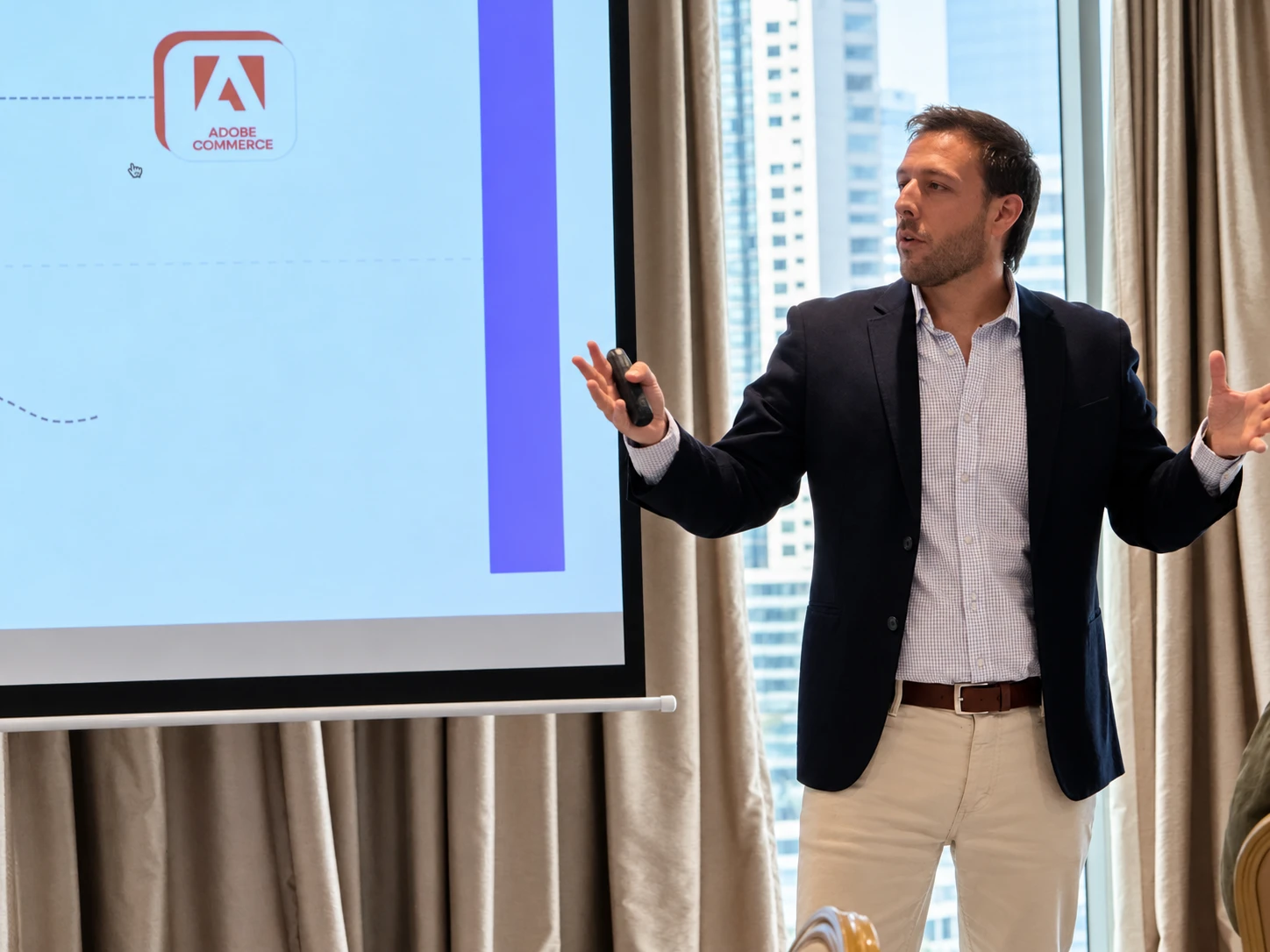
Why would a services company build its own products?
It’s a natural evolution. When your day-to-day work is solving clients’ problems, over time you start to see beyond the individual project.
We saw it clearly in e-commerce. We’ve delivered projects in Uruguay, Chile, Panama, the Dominican Republic, Costa Rica and Colombia, and the same challenges came up every time: connecting the online store with the rest of the business’s systems, keeping inventory, pricing and promotions up to date, and loading products in bulk. The country and the industry changed, but the underlying problem was the same.
When a pattern repeats like that, it stops being one client’s problem and becomes a market opportunity. It makes no sense to solve something we already understand deeply from scratch, project after project. That’s how Weavee was born. Something similar happened with knowledge management: many organizations have the information, but can’t get it to the people who need it. That’s where Datialog came from.
The market has also become more diverse. Some clients want a custom solution. Others prefer to build on Google Cloud or AWS, or to bring AI into their operations with Microsoft Foundry. And others just want to buy a SaaS product and have us guide the implementation. Having our own products, combined with our experience across those ecosystems, lets us meet every one of those scenarios. Products don’t compete with services. They make them stronger.
How does a product come to life at Onetree?
Ideas come from two places. The first is the patterns we see across projects, as with Weavee. The second is the market: we closely follow what’s happening in the industries we work in, like retail, healthcare and education, and ask ourselves what we could bring to our clients with an innovative twist. Today AI cuts across every one of those industries, and together with partnerships like ours with Microsoft, it opens up a unique moment.
To decide what to pursue, every idea has to move one of two needles: the value proposition, aimed at selling more, or internal efficiency, aimed at lowering operating costs. If it doesn’t move either one, it doesn’t move forward.
And not everything has to become a branded product. Often what we build with a client is a combination of technology and process designed around their specific reality. It doesn’t need a name, and it’s still innovation. Our approach is a mix: we set out to create products, but above all to create value for the client.
What problems do Weavee and Datialog solve?
Weavee is an integration platform as a service. It connects the e-commerce platforms, ERPs and CRMs a company’s operations run on, transforms the data in the cloud and keeps it consistent. It was born in retail, where inventory, prices and catalogs are constantly changing, and today we also apply it in education and healthcare.
Our projects taught us that the problem isn’t integrating, it’s maintaining. Connecting two systems is a project with a beginning and an end. The real challenge shows up months later, when a new channel is added, an API changes or the person who built the integration leaves. That’s why Weavee is a managed platform, with a team that makes sure everything keeps running. It also connects AI agents with the company’s systems, so an AI initiative doesn’t end up as a spreadsheet someone has to retype. Today it supports the operations of companies like Bastien, Caren, Cedisur, Piliandina, Minuto Verde, LTL Group and ConwayClick.
Datialog is a knowledge management platform. It organizes and versions an organization’s information and makes it available through a conversational assistant that only answers with current information. Sales, HR and corporate social responsibility teams use it through WhatsApp, Teams, Slack or the company’s website.
Both share one principle: high impact, with flexible pricing models so that small and large companies alike can benefit from them.
What’s the hardest part of building your own product?
When you work for a client, a lot of questions come already answered: the client knows what they want to solve, sets the priorities and signs off on the result. With your own product, all of those decisions are yours, and so is the investment.
The hardest part is deciding what to build. In a project, the need arrives with a name and a face. With a product, you have to distill what many different clients need into a standard offering. That means resisting the urge to customize everything, which is exactly what we’re good at in services.
With AI and a focused team, you can get to a first MVP quickly these days. The real challenge comes next: taking it to market. Every product is a small startup that has to earn its place. And since we tend to look for blue oceans, where there are no established competitors yet, we often have to explain the problem before we can sell the solution.
At its core, it’s a shift from asking “What does this client need?” to “What does everyone need, and how do we sustain it over time?”
Anything you learned the hard way?
That the market ends up shaping a lot of your decisions. You start out with a clear vision, but as soon as you work with real clients, customization requests start coming in, and early on every client counts. Our platforms are multi-tenant: every client shares the same platform, so each new feature affects the entire customer base, not just whoever asked for it. That forces us to think very carefully about what we add and what we leave out.
And yes, we’ve had to scrap features. With Weavee, we believed it was key for clients to be able to modify their integrations through visual diagrams, connecting blocks with a few clicks. We put a lot of effort into designing it. But we realized that people now work with AI assistants: they’d rather type to an agent than drag boxes around a screen. That feature became a conversation with an agent that, through MCP (the protocol that lets AI agents connect to tools and systems) and drawing on our documentation, builds the connections between systems.
The lesson is not to fall in love with your ideas. Things change so fast that we now work with a short-term roadmap, which we adjust as we see how the market evolves.
What carries over from your products to client projects?
A lot. The product team works as an innovation space with no risk to clients. The products we launch have to be robust, but along the way we have a freedom that doesn’t exist in a client project: we can try new technologies, make mistakes and throw things out without affecting anyone’s budget, systems or data.
What we learn there spills over into the whole organization. We redesigned our UX/UI design process from the product side, and part of that process is now used in our services projects. We’re also consolidating our own agent-based software development process, covering planning, QA, monitoring, fixes and ticket creation, always with human oversight. We couldn’t have tested that directly with a client; we did it in-house.
The result is that clients get practices that have already been proven in our own products, on our own dime. And having lived through what it takes to build, validate and sell a product makes us better partners for companies taking on their own. It’s a cycle: projects show us the patterns, and products give us back knowledge and judgment.
What’s next for the product team?
We’ll keep building products, both our own and for clients. But what’s next is bringing that capacity for innovation much closer to each client, through the same two exercises we use to evaluate our own ideas.
On one side, the value proposition: optimizing channels, improving the sales process or making more data available to their own customers. On the other, efficiency: repetitive tasks, or tasks that require cross-checking many sources of information, supported by AI. That’s where people stop carrying out error-prone work and move into a supervisory role.
The product team started as an internal space for turning patterns into products. Today it’s evolving into a continuous improvement lab, much closer to each client. Because in the end, that’s what it’s all about: turning innovation into tangible value.
Behind every product, a method
Weavee and Datialog are the visible side of a way of working. Behind them is a method we repeat: spot a pattern, validate it before building, iterate fast and don’t fall in love with your ideas. It’s the same method we now bring to every client project.
If your organization has a problem that keeps coming back, or an AI initiative that can’t get past the pilot stage, let’s talk.